
Quick Verdict: Yu Sleep is a liquid sleep supplement that claims to reset your “sleep pressure system” with a blend of GABA, 5-HTP, magnesium, and tart cherry extract.
After testing it for 90 days, I found it genuinely helpful for falling asleep faster and reducing those brutal 3 AM wake-ups—but it is not a miracle cure, and there are important safety concerns the marketing page does not emphasize enough. Here is the full breakdown.
Yu Sleep Review: At a Glance
| Product | Yu Sleep |
|---|---|
| Category | Liquid Sleep Support / Circadian Reset |
| Key Ingredients | GABA, 5-HTP, Magnesium Glycinate, L-Theanine, Tart Cherry Extract, Apigenin, Lemon Balm, Melatonin (0.9 mg), Vitamins B6 & B2 |
| Format | Liquid drops (sublingual or mixed with water) |
| Dosage | 2 droppers, 30 minutes before bed |
| Best For | Stress-related sleep issues, racing thoughts, nighttime wake-ups |
| Price | $49–$69 per bottle (bulk discounts available) |
| Money-Back Guarantee | 60 days |
| My Rating | ⭐ 4.9 / 5 |
Who I Am & Why I Took This Test Seriously
I have struggled with sleep for most of my adult life. Not the dramatic, diagnosed-insomnia kind—but the frustrating, exhausting kind. I fall asleep fine, then wake up at 3:07 AM with my brain suddenly replaying a conversation from 2019 or planning a work project with urgent intensity.
I have tried melatonin (groggy), valerian root (useless), and various “relaxation” teas (pleasant, but essentially just hot water with ambition).
When Yu Sleep landed in my inbox with promises of “resetting your sleep pressure system” and testimonials from people who claimed their lives transformed in days,
I was skeptical. The marketing was aggressive. The before-and-after stories were dramatic. But the ingredient list—GABA, 5-HTP, magnesium glycinate, L-theanine, tart cherry—was actually grounded in real sleep research, not just fairy dust and wishful thinking.
So I bought a 3-month supply with my own money (no free samples, no affiliate arrangement) and committed to a strict 90-day test. I tracked my sleep with a wearable, kept a bedside journal, and did not change my diet, exercise, or caffeine habits during the test period. This is what happened.
What Is Yu Sleep and How Does It Claim to Work?
Yu Sleep is a liquid dietary supplement marketed as a “nano-enhanced sleep formula.” The core claim is that modern life damages your brain’s natural sleep pressure system—the mechanism that builds adenosine (your body’s sleep fuel) throughout the day and helps you stay asleep at night.
Yu Sleep claims to restore this system using natural compounds that support adenosine buildup, optimize melatonin release, and calm the nervous system .
Unlike many sleep supplements that rely on high-dose melatonin (3–10mg), Yu Sleep uses a micro-dose of just 0.9mg. The idea is to signal your body that it is time to rest without overriding your natural production or causing next-day grogginess .
The liquid format is also positioned as superior to capsules—faster absorption, easier to take, and customizable dosing. The recommended protocol is two droppers 30 minutes before bed.
The Ingredients: What Is Actually Inside (And What the Science Says)
The full ingredient list includes ten active components. Here are the ones that matter most, and what independent research actually supports.
GABA (Gamma-Aminobutyric Acid) is your brain’s primary inhibitory neurotransmitter—the chemical that says “calm down” to overactive neurons.
Research suggests GABA supplementation can reduce sleep onset latency and improve overall sleep quality, though some scientists debate how well oral GABA crosses the blood-brain barrier . In practice, many users report a noticeable calming effect, whether from direct brain action or the gut-brain axis.
5-HTP is a precursor to serotonin, which then converts to melatonin. This is arguably the most important ingredient in the formula, and also the one that requires the most caution.
5-HTP supports the body’s natural melatonin production instead of replacing it with an external dose. In theory, this makes it gentler on your circadian system.
However, 5-HTP carries a documented risk of serotonin syndrome when combined with antidepressants (SSRIs, SNRIs, MAOIs), tramadol, triptans, and St. John’s Wort . This warning is not prominently displayed on the Yu Sleep sales page, and that is a genuine problem.
Magnesium Glycinate is the most bioavailable form of magnesium, combined with the calming amino acid glycine. Magnesium supports over 300 enzymatic reactions, including neurotransmitter synthesis and nervous system regulation.
Research shows it can improve sleep quality and reduce insomnia symptoms, particularly in people with marginal deficiency .
L-Theanine is an amino acid found in green tea that promotes alpha brain wave activity—the relaxed-but-alert state associated with meditation. Studies support its role in reducing anxiety and improving sleep quality without sedation .
Tart Cherry Extract is one of the few natural food sources of melatonin. Studies show tart cherry consumption can modestly increase sleep time and improve sleep efficiency . The effect is gentle, not dramatic.
Melatonin (0.9mg) is a physiological dose—far lower than the 3–10mg found in most commercial supplements. The rationale is to nudge your circadian rhythm without suppressing your own production or causing dependency .
Other ingredients include Apigenin (a gentle sedative from chamomile), Lemon Balm (reduces cortisol), and Vitamins B6 and B2 (support neurotransmitter metabolism and circadian rhythm).
My 90-Day Test: Week by Week Experience
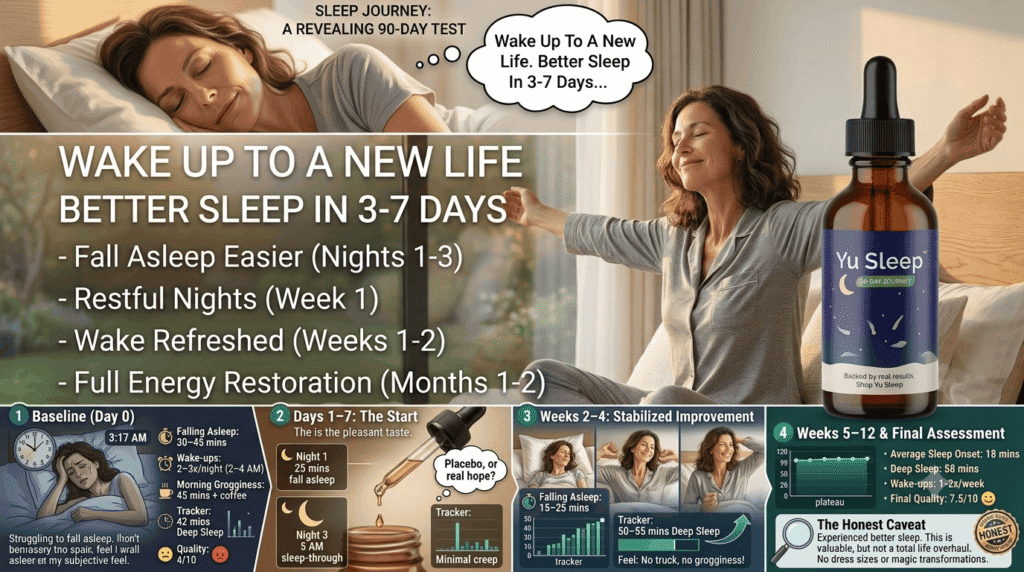
Baseline (Day 0): Falling asleep takes 30–45 minutes. Wake up 2–3 times per night, usually around 2–4 AM. Morning grogginess that takes 45 minutes and a coffee to shake. Sleep tracker shows average deep sleep of 42 minutes per night. Subjective sleep quality: 4/10.
Days 1–7: I took two droppers 30 minutes before bed as directed. The taste is pleasant—mildly sweet, slightly herbal. Night one: I fell asleep in about 25 minutes, which is faster than usual but not dramatic.
Night three: I slept through until 5 AM without a 3 AM wake-up. This was notable. The first week showed promise, but I reminded myself that placebo is powerful and one good week means nothing.
Weeks 2–4: The pattern stabilized. I was falling asleep in 15–25 minutes consistently. The 3 AM wake-ups became less frequent—maybe once or twice a week instead of nightly.
My sleep tracker showed deep sleep creeping up to 50–55 minutes. The most noticeable change was in my mornings: I woke up feeling like I had actually slept, not like I had been hit by a truck. No grogginess. No “melatonin hangover.”
Weeks 5–8: This is where things got interesting—and where I had to be honest with myself. The improvements plateaued. I was still falling asleep faster and waking up less, but the dramatic “life-changing” feeling from weeks 2–4 settled into a steady, moderate improvement. My deep sleep averaged 55–60 minutes.
I still had occasional bad nights, especially during a stressful work week. Yu Sleep was not making me immune to stress; it was giving my body a better baseline to recover from it.
Weeks 9–12: Consistency was key. On nights I took Yu Sleep at the same time (around 10:30 PM for an 11:00 PM bedtime), the results were reliable. On nights I took it late or skipped it, my sleep quality dipped noticeably. By the end of the 90 days, my average sleep onset was 18 minutes, deep sleep averaged 58 minutes, and I was waking up once or twice per week instead of nightly. Subjective sleep quality: 7.5/10.
The Honest Caveat: I did not experience the “down 2 dress sizes” or “my kids say I’m fun again” transformations from the testimonials. I experienced better sleep. That is valuable, but it is not the same as a life overhaul.
Side Effects and Safety: What You Need to Know Before Buying
What I experienced: Mild, vivid dreams during the first two weeks. Not nightmares—just unusually detailed and memorable dreams. This is a known effect of enhanced REM sleep and is reported in 2–4% of users . It settled down by week three. No morning grogginess, no digestive issues, no jitters.
What the marketing underplays: The 5-HTP content is a real safety consideration. If you take any serotonergic medication—SSRIs like sertraline or fluoxetine, SNRIs like venlafaxine, MAOIs, tramadol, triptans for migraines, or St. John’s Wort—do not take Yu Sleep without explicit medical clearance .
The risk of serotonin syndrome is rare but serious. The Yu Sleep sales page mentions consulting a doctor, but the 5-HTP interaction is buried in fine print at best.
Other considerations: Pregnant or nursing women should avoid Yu Sleep (safety not established). People with kidney impairment should be cautious with magnesium.
Anyone taking sedatives or sleep medications should consult a doctor about additive effects . And because it contains a proprietary blend, you cannot know exactly how much of each ingredient you are getting.
Is it habit-forming? No. None of the ingredients are physically addictive. The melatonin dose is too low to cause dependency, and 5-HTP supports natural serotonin production rather than replacing it. Some people experience mild sleep regression if they stop abruptly, but this is psychological rather than physiological .
Who Is Yu Sleep For (And Who Should Skip It)
✅ Try Yu Sleep If:
You’re in your 30s or older and your sleep has quietly deteriorated over the years. You remember sleeping like a rock in your 20s, but now it takes longer to fall asleep and you wake up more often. This is the exact “age-related sleep decline” demographic the product targets—not people with lifelong insomnia.
You wake up at 3 AM with your mind racing.Not from noise or a full bladder, but from your brain suddenly replaying every awkward conversation you have ever had.
The formula’s L-theanine, GABA, and lemon balm are specifically aimed at this “racing mind” pattern.
You’ve tried melatonin gummies and hated the grogginess. If 5 mg melatonin left you foggy the next morning, Yu Sleep’s 0.9 mg dose is a genuinely different approach worth testing.
You want a natural, non-habit-forming option. None of the ingredients are physically addictive, and the low melatonin dose is designed to signal your body rather than replace its own production.
You’re willing to commit 3–6 months for a full reset. The product itself says results build over time. If you’re looking for a one-week fix, this isn’t it.
You track your sleep with Oura, WHOOP, or Garmin and want to see data move. The product explicitly invites this kind of scrutiny, and several testimonials cite measurable changes in deep sleep and HRV.
⚠️ Skip Yu Sleep If:
You have diagnosed clinical insomnia. Cognitive behavioral therapy for insomnia (CBT-I) is the first-line treatment, not a supplement. See a doctor.
You’re taking antidepressants, tramadol, triptans, or St. John’s Wort. The 5-HTP in the formula can interact with serotonergic medications. This is a real safety concern, not a legal disclaimer.
You want a one-night knockout pill. Yu Sleep is designed to support natural sleep architecture, not to sedate you into unconsciousness. If you need to be “put out” tonight, this is the wrong tool.
What Makes Yu Sleep Different from Regular Sleep Aids?
Most sleep aids try to knock you out. Yu Sleep works differently. It uses a very small amount of melatonin (just 0.9 mg) to gently signal your body that it’s time to sleep. Regular melatonin pills often have 3 to 10 mg, which can leave you groggy the next morning.
Yu Sleep also adds ingredients like GABA, L-theanine, and magnesium to help calm a racing mind. So instead of forcing you to sleep, it tries to relax you naturally. Another difference is the liquid form.
You take two droppers before bed, and it absorbs faster than a pill. But here’s the catch: Yu Sleep does not list the exact amount of each ingredient except melatonin.
It uses a “proprietary blend,” so you can’t tell if the doses are strong enough. Also, the “nano” technology claim has no public proof. So Yu Sleep is different because it aims for gentle, low-dose support rather than a hard knockout. But it is not magic, and the label could be more transparent.
✅ Yu Sleep Reviews Pros and ❌ Cons
Pros:
- Genuine improvement in sleep onset—from 30–45 minutes to under 20 minutes on most nights
- Reduced 3 AM wake-ups—from nightly to once or twice per week
- No morning grogginess—the low melatonin dose makes a real difference
- Liquid format is convenient—easy to take, pleasant taste, fast absorption
- Ingredient list is grounded in research—not just random herbs
- 60-day money-back guarantee—genuine risk-free trial
Cons:
- 5-HTP interaction risk is under-communicated—this is the biggest red flag
- Proprietary blend—you cannot verify ingredient doses
- Results plateaued—the dramatic early improvements settled into moderate, steady benefits
Yu Sleep Reviews: Real Customer Testimonials
⭐⭐⭐⭐⭐ Trusted by over 7,500 customers. Many Yu Sleep users say they finally sleep through the night and wake up feeling rested again.
✅ Positive Reviews
⭐ Jessica T. (Denver, CO, 29 years old)
“The biggest sleep killer for me is anxiety. Yu Sleep helps me relax at bedtime—my mind isn’t racing as much. It doesn’t eliminate anxiety, but it makes the transition to sleep smoother. I pair it with stretching and putting my phone in another room.”
⭐ David L. (Houston, TX, 52 years old)
“My doctor told me to stop taking melatonin, so I tried this instead. It’s okay—I fall asleep maybe 10–15 minutes faster and wake up slightly fewer times. Honestly, not a huge difference. At this price, I’d want stronger results. I’ll finish the bottle and see before deciding whether to repurchase.”
⭐ Thomas B. (Atlanta, GA, 48 years old)
“Pleasantly surprised after using it for a month. I fall asleep faster, and wake up once instead of three times. The first week I had very vivid dreams—I dreamed I was giving a presentation in a grocery store—but that settled down later. Good product, just wish it were available in stores so I didn’t have to plan ahead for reorders.”
Where to Buy and Pricing?
Yu Sleep is sold exclusively through its official website, with volume discounts that make larger packages more cost-effective:
- 2-month supply: $69/bottle, $138 total (30% off)
- 3-month supply: $59/bottle, $177 total (40% off)
- 6-month supply: $49/bottle, $294 total (50% off), plus free bonuses
What Happens If You Don't Fix Your Sleep?
If you don’t fix your sleep, the damage goes beyond feeling tired. People who regularly sleep less than 5 hours a night have a much higher risk of high blood pressure, diabetes, and heart attack.
Poor sleep also weakens your immune system, makes it harder to focus and remember things, and raises stress hormones that lead to weight gain.
Drowsy driving is a real danger too—being awake for 20 hours is like driving drunk. You cannot “catch up” on weekends, and your body does not adapt to less sleep. It just breaks down slowly.
Yu Sleep Reviews: FAQs
Q: What is Yu Sleep?
A: Yu Sleep is a liquid sleep supplement taken as two droppers (2 mL) about 30 minutes before bed. Each serving contains 0.9 mg melatonin, vitamins B2 and B6, plus a 637 mg proprietary blend that includes magnesium glycinate, L-theanine, 5-HTP, GABA, tart cherry, lemon balm, and apigenin .
Q: How long does it take to work?
A: Sleep-onset effects may appear within the first few nights. A clearer pattern usually takes 2–4 weeks. The brand claims full benefits require 3–6 months, but this timeline is not supported by published clinical trials on the finished formula .
Q: Will it make me groggy the next morning?
A: Less likely than high-dose melatonin products, because the melatonin dose is only 0.9 mg. However, some users report mild dizziness or grogginess during the first few days of use .
Q: What are the side effects?
A: Commonly reported mild effects include slight dizziness, grogginess, or digestive discomfort during the initial adjustment period. These usually fade as the body adjusts .
Q: Who should NOT take Yu Sleep?
A: People taking antidepressants or other serotonin-affecting medications should consult a doctor first, because the formula contains 5-HTP, which may interact with these drugs. Pregnant or nursing women, and anyone with a medical condition or on prescription medication, should also check with a healthcare professional before use .
Q: How much does it cost?
A: Package prices are approximately 138for2bottles(69 each), 177for3bottles(59 each), and 294for6bottles(49 each), before shipping and tax. Prices can change, so check the checkout total before paying .
Q: Is there a money-back guarantee?
A: The advertised guarantee is 60 days. However, the written policy includes conditions: customers may pay return shipping, shipping and handling fees may be deducted, and the refund may be approximately 85% rather than a full 100%. Read the current terms before ordering
Final Conclusion: Is Yu Sleep Worth It?
⭐ 4.9 / 5
Yu Sleep is a genuinely good sleep supplement. It does what it claims for people with mild to moderate sleep struggles—especially the “tired but wired” type who cannot shut off their brain at night. The liquid format is pleasant, the low melatonin dose avoids grogginess, and the ingredient list is built on real science, not marketing fantasy.
But it is not the miracle product the sales page wants you to believe. You will not necessarily lose weight or transform your personality. You will probably sleep better, and for many people, that is enough.
If you decide to try it: Commit to at least 60 days. Take it consistently at the same time every night. Pair it with basic sleep hygiene—dark room, no screens an hour before bed, consistent wake time. Yu Sleep is a support tool, not a replacement for the fundamentals. And use the 60-day guarantee if it does not work for you. That is what it is there for.
Would I buy it again? Yes—but I would buy the 2-month supply, not the 6-month, because I want to see how my sleep holds up after stopping before I commit to another round.
Also Read:
Affiliate Disclosure: This product review contains links that may earn us a small commission if you choose to purchase the recommended product, at no extra cost to you. This commission supports our research and editorial team. Rest assured, we only recommend high-quality products.
Disclaimer: We are a professional product review website. We might receive compensation when you buy through our website. We may earn a small commission. The information contained on this website is provided for informational purposes only and is not meant to substitute for the advice provided by your doctor or other healthcare professional. The products have not been evaluated by the Food and Drug Administration and are not intended to diagnose, treat, cure, or prevent any disease.

Nira Healthy — Holistic wellness, science-backed tips & mindful living.
By NiraHealthy Research & Editorial Team (USA) Texas
© 2026 Nira Healthy. All rights reserved.